Added subdomain to DDNS and Names. Let’s Encrypt worked fine. Tried to install Home Assistant choosing the subdomain as the domain name for it but when I launch home assistant, I get an exact duplicate of FBX/Plinth from the main url showing at the subdomain url.
https://pauldingtree.com/freedombox/
https://tunnel.pauldingtree.com/freedombox
I have HA installed on my local NAS OS, UmbrelOS, and it’s doing what I need with a custom component. I have some automation modules that I wanted on HA and got them working. I’d really like to access those from the web which is why I tried installing HA on FBX.
The tunnel subdomain was created in dynu a year ago but maybe I need some configuration on dynu .com
I do also have *.pauldingtree.com wildcard so maybe I don’t need the tunnel.pauldingtree.com subdomain?
I think there is a bug currently with Home Assistant’s Apache configuration file. I am investigating and will have a fix soon. However, you might be able to workaround the problem with the following commands on the terminal as root:
cd /etc/apache2/includes
ln -s home-assistant-freedombox.conf <subdomain>-include.conf
You need to replace <subdomain> with tunnel.pauldingtree.com. I will have more information tomorrow.
The problem was that the app was not being enabled properly immediately after install. So, the solution to the problem is to disable and re-enable the app (the ‘ln’ command I gave was not necessary).
I submitted two fixes. The first adopts to the new configuration format the Home Assistant introduced very recently for HTTP parameters. The second fixes the problem you describe (disable and re-enable after app install should not be required). Unfortunately, we missed the window for this week’s release. So, the fixes will reach you only after 2 weeks.
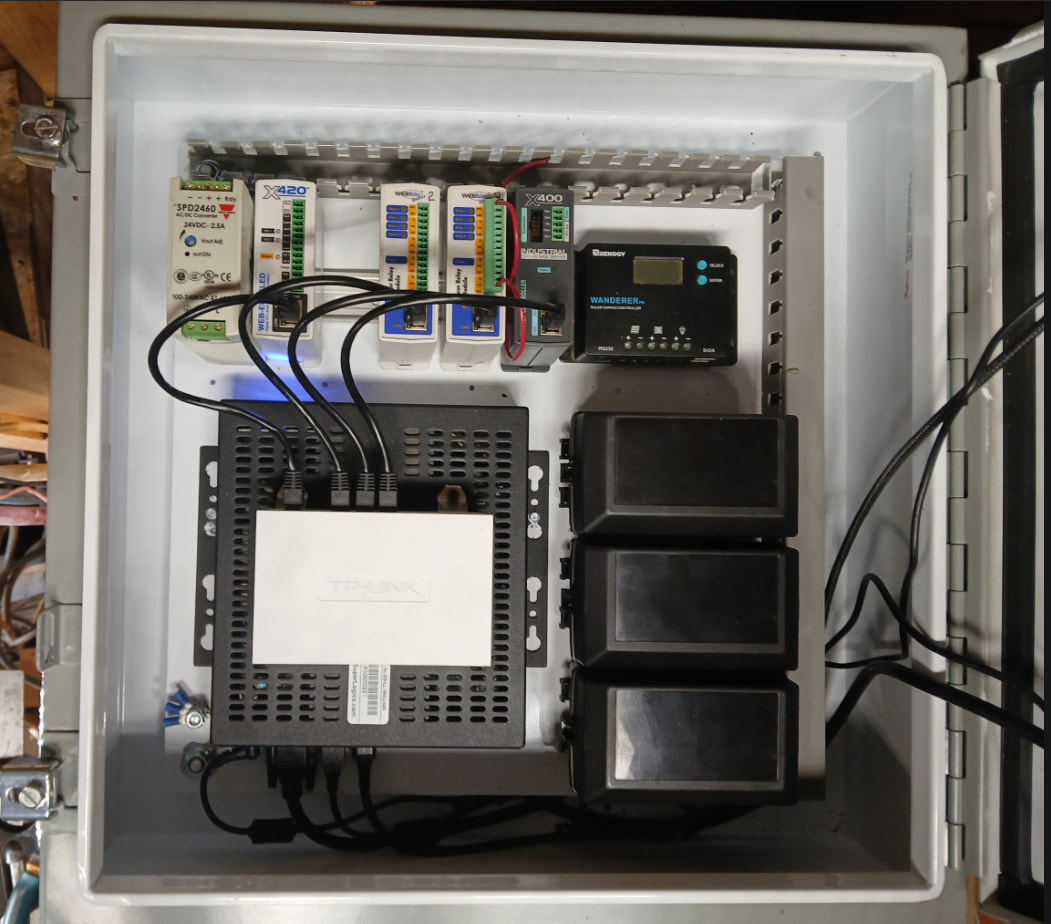
This is the control panel enclosure for the high tunnel I’ll be automating, with power supply, most of the CBW control modules in it, solar charge controller, network switch, industrial PC, and three fuse/relay boxes. The door to the enclosure has an industrial touch screen monitor in it. It will live in the shed extension to the hoophouse/high tunnel that it will control. There will be a LOT more wiring in it later on.
Each of the control modules has a built in mini web server for setup pages and a monitor/control page but the control logic is limited due to processing power and storage limits. For instance, AND has a limit of two of them.
You can increase the limits by writing scripts in a small subset of the ancient BASIC programming language. Their top line master controller uses the LUA language but either way, I’m not a programmer.
HA’s GUI popups, selects and a bit of human readable yaml code will do just fine.
To customize HA, I have downloaded some “automations” that I found on Home Assistant forum. The experience was smooth and I didn’t have to fiddle with the yaml files. The entire setup has been running stably for more than a year now.
I’m browsing the Custom Component forum now. These people are extreme. Found a very advanced irrigation automation. He did a ton of research and cites scientific studies. It’s probably more fully featured than any paid product. I love the open source community.
My irrigation setup is quite simple, I am turning on once a day for a fixed amount of time and then turning it off. I would love to improve it. Do share some pointers.
This is the irrigation integration which is a bit much for me, for now at least.
They say your fingers are the best guide. Does it feel dry, moist or wet? That would be at tap root level which varies by plant type.
They also say you can’t over water good soil. Excess drains away while it keeps plenty for the plants to get as needed.
Someday I hope to have good soil. I have brownish yellow Clayey Loam but it doesn’t take a lot to make it dark and fluffy.
I plan on using soil moisture sensors to trigger drip irrigation but I’ll have to use the feel method to know what the sensor reading means. They read different in different soils so it’s a guide only after some observation.
It’s such a variable thing. Different soils, different climates, different annual rain amounts, different plant needs.
I’ve only watered daily once to get some tomato plants through a heat wave. Just a little every day so I wouldn’t cause a tomato splitting event but the soil also wouldn’t turn into concrete.
I can generally get away with once a week. In cold weather, once a month. That’s with mulch.
My NAS is not online but you know how that goes. You pay a service and they’ll get it to it and put it online. I got a free 30 trial with Nuba Casa, a Home Assistant service. It was pretty cool seeing my dashboard and turning a light on in the house from 8 miles away.
I’ll have to create a read-only User in HA and use that unless I see something that needs attention. Of course it’s automation. If something fails, it’s likely electrical or mechanical and not something I can fix remotely.
Freedombox updated to 26.14 this morning. I’m in Home Assistant now. It’s installed at the tunnel. subdomain as desired.
Success
I thought about using the restore from backup I did of the NAS HA but Umbrel’s container might be different than FBX/HA version so I’m starting from scratch.
I don’t have many sensors connected and any Integrations, themes and cards are easy to reinstall. I only have one automation.
It will be a cleaner install with a fresh empty database. I had some sensors that were updating every 1 second. I found where to change that and will do so immediately upon installing that integration this time.
I can now cancel the Nabu Casa plan before the free trial ends.